Why this case is common
Split-level and ranch homes built across the metro in the 1970s frequently have sprayed acoustic texture in kitchens and adjoining rooms. Stovetop fires are among the most frequent household fires. When the two meet, the ceiling is usually one of the first things a restoration contractor wants to remove, because it holds smoke odor and is often charred or soaked.
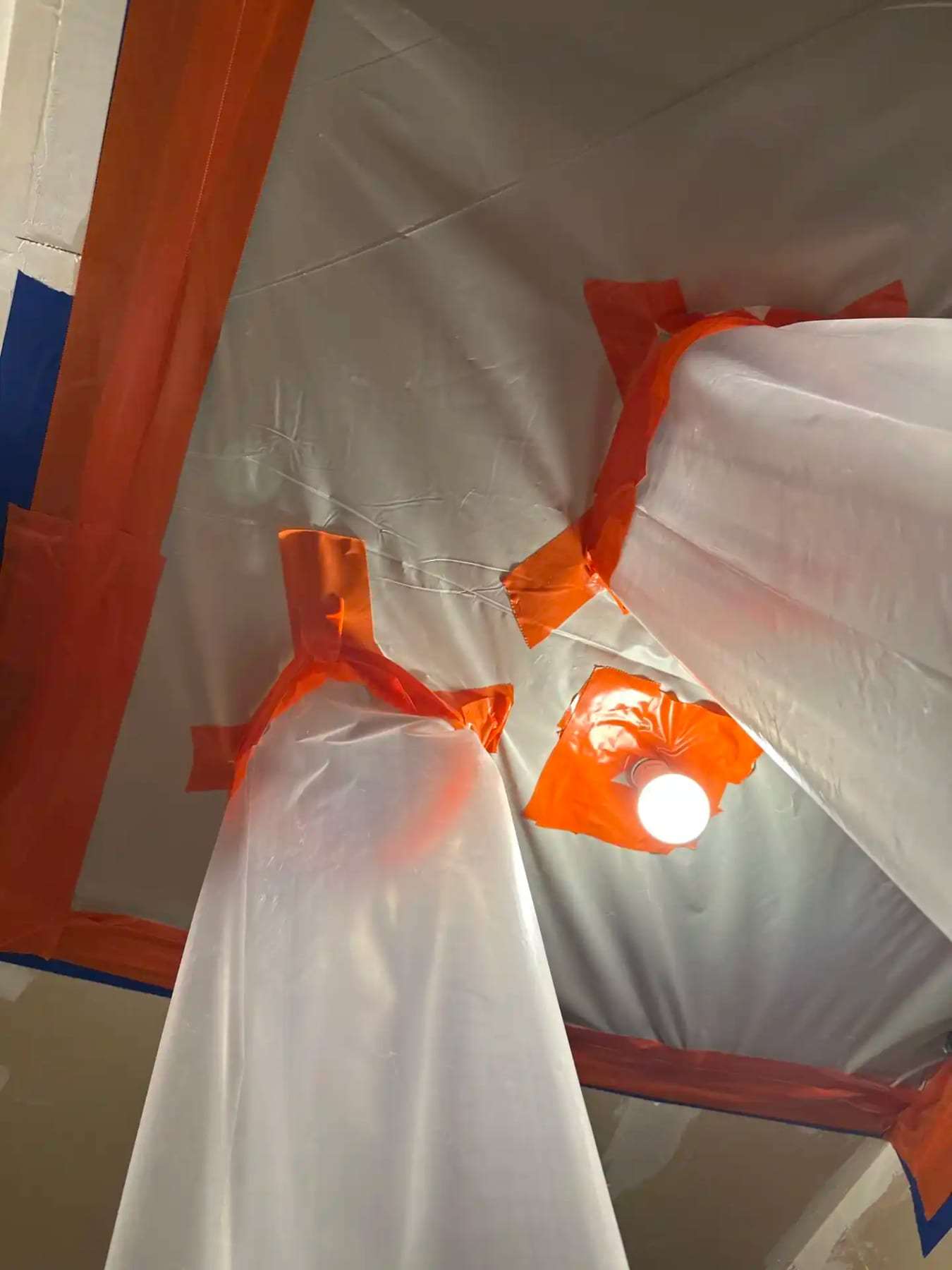
Plastic containment taped over a ceiling with a work light shining through. A general example of this kind of work, not a photo of a particular home, business or job.
The situation
Illustrative example. Not a real job or customer.
A pan fire spreads to the range hood in a 1970s split-level. The fire department extinguishes it. The kitchen ceiling texture is scorched above the range, and smoke has stained the texture through the open dining area. Firefighting water has dripped through to the lower level.
- The owners wait outside until the fire department says the house can be entered and the gas and electric utilities have checked their service.
- The insurer sends a fire restoration contractor, whose initial plan is to remove all ceilings on the main level the next day.
- One of the owners asks whether the ceiling texture has been tested. The contractor says it has not.
- The owners ask the adjuster to approve asbestos inspection before tear-out, explaining the age of the house.
- A CDPHE-certified inspector samples the ceiling texture, the kitchen flooring and the drywall in the water-damaged lower-level ceiling.
- The ceiling texture is positive. The flooring and lower-level drywall are negative.
- A certified abatement contractor removes the main-level ceiling texture and affected drywall under containment. Fire restoration of contents and lower-level drying proceed separately.
The ceiling was removed under controls rather than torn down in an open, occupied-adjacent house. Restoration and abatement schedules were coordinated, and clearance came before the new ceiling was hung.
Decision points in this case
- IfThe contractor plans to remove ceilings before testingThenThe owners pause the tear-out and ask for inspection first.
- IfOnly some materials are positiveThenNegative materials, like the lower-level drywall here, can be removed by the restoration contractor without waiting for abatement.
- IfSmoke cleaning of contents is neededThenContents can be packed out and cleaned off site while abatement is planned.
- IfThe adjuster asks why the ceiling needs special handlingThenThe owners send the lab results and the abatement scope.
Questions the owners asked
- Can you show me the certification of everyone who will work on the ceiling, so I can check it with CDPHE?
- How will containment protect the stairs and the lower level?
- Will clearance be done by a separate firm?
- Can the restoration contractor start on the lower level while abatement is underway upstairs?
- When can we expect to move back into the main level?
General information for the Denver area, not a quote or professional advice. In an emergency, call 911.