The situation
Illustrative example. Not a real job or customer.
A couple buys a 1920s brick bungalow in central Denver. The original radiators work, but the boiler is near the end of its life. They collect bids for a new high-efficiency boiler. The basement has wrapped supply and return pipes along the joists and a thick jacket on the boiler itself.
- Before choosing a bid, the owners ask each heating contractor how they plan to deal with the pipe insulation. Two say they will cut it off where they need to; one says it should be tested first.
- The owners hire a CDPHE-certified building inspector to sample the boiler jacket, each type of pipe insulation and the basement floor where the new unit will sit.
- The pipe insulation and boiler jacket are positive. The concrete floor has no suspect covering.
- The owners decide whether to remove all pipe insulation or only the sections the heating work will disturb, after talking it through with a certified abatement contractor.
- They choose to remove all basement pipe insulation now, since they plan to finish the basement later.
- Abatement happens first, under containment, followed by independent clearance.
- The heating contractor installs the new boiler and reinsulates the pipes with modern material.
The heating job started a little later than planned but ran without stops. The owners have a clean basement ready for future finishing, and paperwork that will matter when they sell.
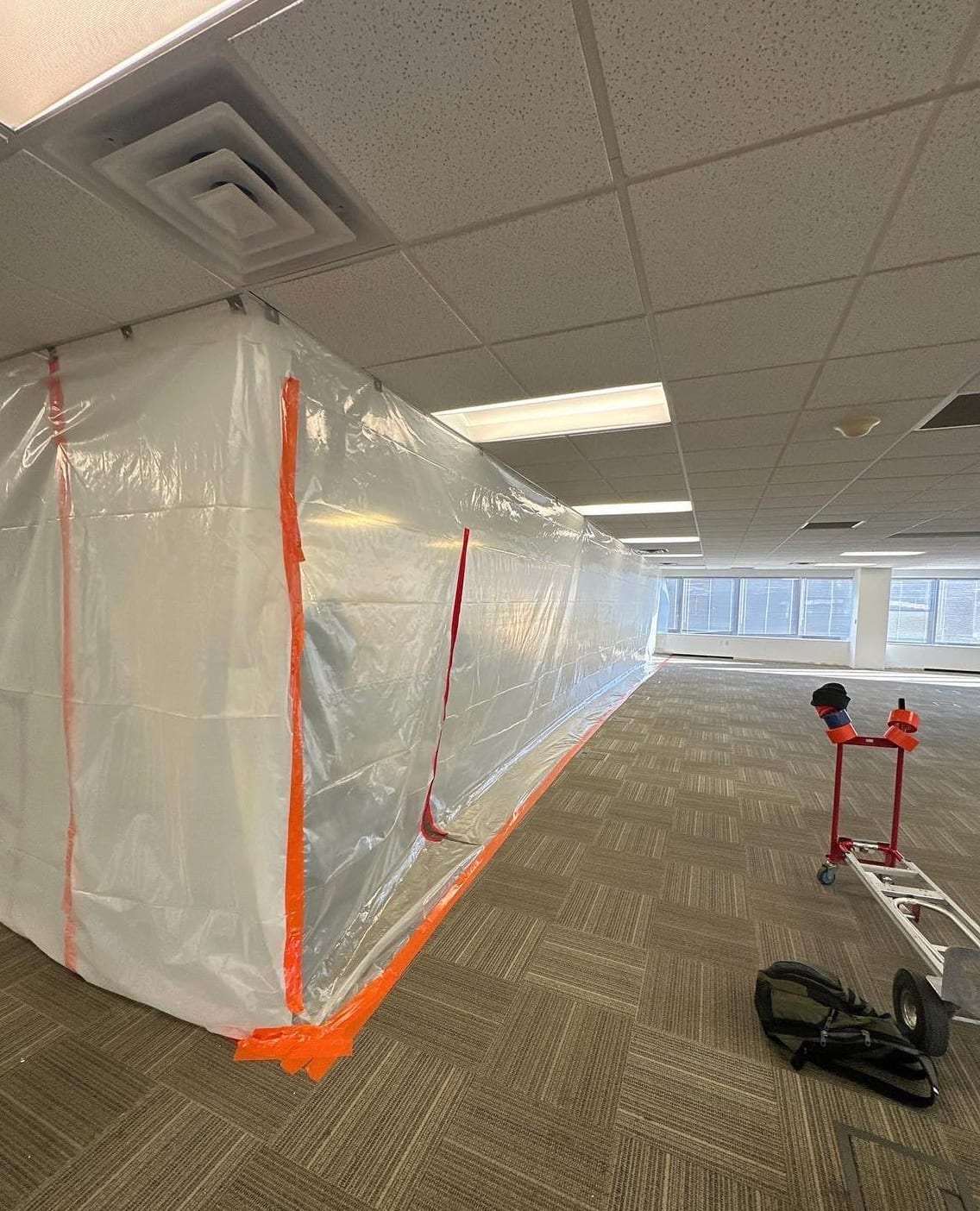
Office floor divided by a long plastic containment wall. A general example of this kind of work, not a photo of a particular home, business or job.
Options the owners weighed
| Option | Pros | Cons |
|---|---|---|
| Remove only what the boiler swap disturbs | Smaller abatement scope now | Remaining wrap must be managed and removed later before finishing the basement |
| Remove all basement pipe insulation | One project, one containment, basement ready for future plans | Larger scope up front |
| Encapsulate remaining intact sections | Avoids removal where material is in good shape | Material stays; future work still has to address it |
The owners' key choices
- IfA heating bid planned to cut through untested insulationThenThe owners set that bid aside.
- IfInsulation tested positiveThenAbatement was scheduled first, separate from the heating contract.
- IfFuture basement finishing was likelyThenThe owners chose full removal rather than partial.
- IfRadiators upstairs had no suspect materials on themThenThey stayed in place and connected to the new boiler.
Documents the owners kept
- Inspection report with lab results.
- Abatement scope and certification details checked with CDPHE.
- Clearance results.
- Waste shipment record.
- The heating contractor's installation paperwork and permit.
General information for the Denver area, not a quote or professional advice. In an emergency, call 911.